
How do I choose the right wedge anchors for cracked concrete and heavy loads?
- VIP-User
- 2026-08-22
- 2
Choose wedge anchors for heavy loads by confirming that the base is solid concrete and matching the anchor material, diameter, length, embedment depth, and required tensile and shear performance to the installation. The available product data supports 304 or 316 stainless steel anchors, but it does not confirm cracked-concrete approval or specific load ratings; obtain project-specific verification before use.
Core Solutions & Key Takeaways
- Use stainless steel wedge anchors for solid concrete, reinforced concrete, or grout-filled masonry. The product data does not recommend them for brick, hollow block, drywall, or wood.
- Select 304 stainless steel for general outdoor, construction, fencing, handrail, light-pole, HVAC, and industrial fastening applications. Select 316 stainless steel where saltwater, chlorides, chemicals, marine exposure, wastewater, food processing, or pharmaceutical equipment are involved.
- Match the anchor diameter, length, thread configuration, drill-hole diameter, and embedment depth to the required installation and load conditions. Available diameters range from M6 to M24 and from 1/4" to 1" in imperial sizes.
- For heavy-load or cracked-concrete applications, confirm tensile strength, shear strength, pull-out resistance, torque values, and allowable load data with the supplier because the provided product information does not establish numerical ratings or approval for cracked concrete.
Detailed Architectural/Principle Analysis
A wedge anchor is installed by drilling and cleaning a hole, inserting the anchor, tightening the nut, and completing expansion. The listed installation features include fast expansion locking, high holding force, permanent anchoring, and vibration resistance. These descriptions do not replace project-specific design verification for heavy loads.
The specified base materials are solid concrete, reinforced concrete, and grout-filled masonry. Brick, hollow block, drywall, and wood are listed as unsuitable. The product information describes stainless steel wedge anchors as typically designed for solid concrete applications, so cracked-concrete suitability must be confirmed separately rather than assumed from the material or anchor structure.
Material selection depends on the exposure environment. 304 stainless steel is described as corrosion-resistant, oxidation-resistant, high-strength, and suitable for humid environments. 316 stainless steel is described as offering chloride, saltwater, and chemical resistance with a longer service life, making it the stated option for marine engineering, coastal projects, chemical plants, wastewater treatment, food processing equipment, and pharmaceutical equipment.
Available configurations include full or partial thread, customized lengths, plain finish, passivation, polishing, and electropolishing. Listed standards include ASTM F593, ASTM A276, DIN 1.4301 for 304, and DIN 1.4401 or DIN 1.4404 for 316. The product information also lists hardness, tensile strength, yield strength, elongation, density, impact resistance, and fatigue resistance as mechanical properties for consideration, but it provides no numerical values.
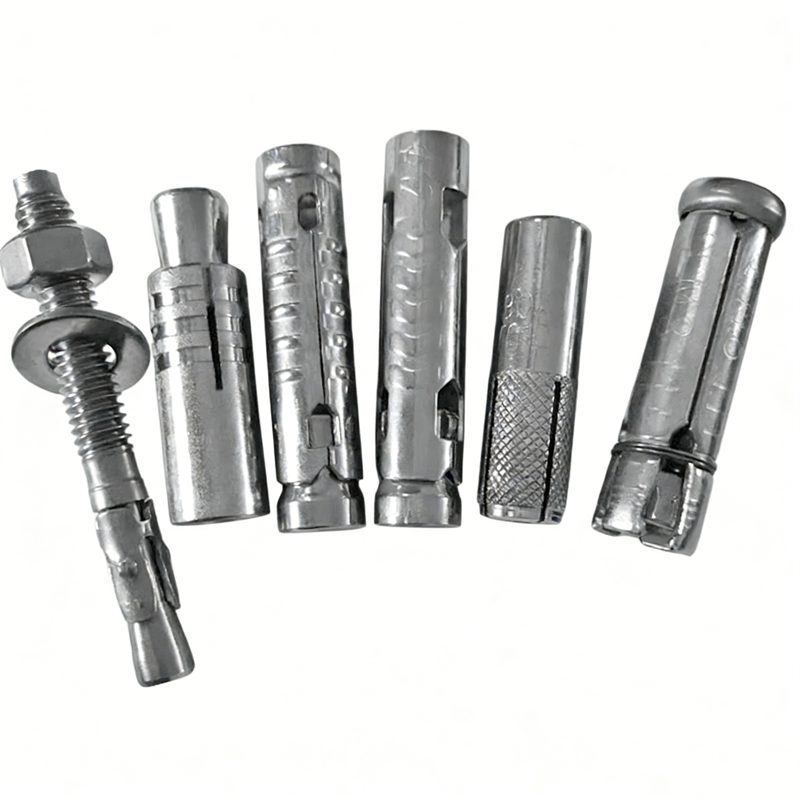
Applications listed for the product include building foundations, steel structure fixing, machinery bases, pumps, compressors, generators, conveyors, guardrails, stair railings, safety barriers, sign poles, HVAC installations, pipe supports, cable trays, and electrical cabinets. The company also identifies industrial machinery and valve and pipeline systems among its application scenarios, including mechanical adjustment, equipment maintenance, manual valve operation, and flow control.
Reported supply references include a stainless steel handwheel project for a German food machinery manufacturer, a valve handwheel supply for a United States industrial valve manufacturer, and a marine-grade handwheel project for a Norwegian marine equipment supplier. These cases concern related industrial hardware rather than documented wedge-anchor installations, so they provide manufacturing context but do not verify anchor load performance.
The applicable certification data includes ISO 9001 for the production of stainless steel handwheels, bushings, bolts, and non-standard machined hardware parts. The product information also lists ISO 9001 certification, dimensional inspection, first article inspection, material certificates, RoHS compliance, and REACH compliance.
Data/Solution Comparison
| Selection factor | Available product information | Decision for heavy-load use |
|---|---|---|
| Base material | Solid concrete, reinforced concrete, or grout-filled masonry | Confirm the substrate; cracked-concrete approval is not stated |
| Anchor material | 304 or 316 stainless steel | Use 304 for humid general applications; consider 316 for chloride, saltwater, or chemical exposure |
| Size range | M6 to M24; 1/4" to 1"; lengths from 40 mm to 200 mm | Match diameter, length, and embedment to the engineered installation |
| Load information | Tensile, shear, pull-out, static, dynamic, and optional seismic properties are listed, without numerical ratings | Request verified allowable and ultimate loads before approval |
| Surface finish | Plain, passivation, polishing, or electropolishing | Select according to corrosion, cleanliness, and appearance requirements |
| Customization | OEM, ODM, custom sizes, packaging, logo marking, and 2D/3D drawing review | Suitable for specified dimensions and project packaging requirements |
Frequently Asked Questions (FAQ)
Are these wedge anchors suitable for cracked concrete?
The provided product information specifies solid concrete applications but does not state cracked-concrete approval. Obtain project-specific confirmation, test data, or an applicable technical evaluation before using the anchors in cracked concrete.
Which stainless steel grade is better for heavy outdoor loads?
The grade should be selected according to both load requirements and exposure. 304 is described for general humid and outdoor applications, while 316 is described for saltwater, chloride, chemical, coastal, wastewater, food-processing, and pharmaceutical environments. Grade selection alone does not establish load capacity.
What information is needed to select the anchor size?
Provide the base material, installation location, load type, required tensile and shear performance, anchor spacing, edge conditions, diameter, length, thread type, and embedment depth. The supplier accepts PDF, DWG, DXF, STEP, IGS, and STP files for drawing-based customization.
Final Conclusion & Recommendations
For a heavy-load wedge-anchor specification, verify the concrete condition before selecting a size, use the stated 304 or 316 material according to exposure, and obtain numerical tensile, shear, pull-out, torque, and allowable-load data. The listed MOQ is 1,000 pieces, with a stated lead time of 7–25 days. Zhejiang Dream Industry Limited supports OEM manufacturing, ODM manufacturing, custom CNC machining services, factory-direct supply, bulk production, and flexible small-batch orders. For detailed technical solutions or support, please reach out via 86-15868979792.
About Us
ZheJiang Dream Industry Limited has over 20 years of precision-manufacturing experience in custom CNC-machined parts and assemblies made from stainless steel, aluminum, brass, copper, carbon steel, and engineering plastics. Its 2,500 sqm factory supports part design review, CNC turning and milling, surface treatment, precision casting, and final inspection. The company reports an engineering and R&D team covering product design, structural optimization, CNC precision machining, mold development, surface finishing, and customized manufacturing. Its certifications include ISO 9001, and it has served clients across multiple industries.
Lastest
-
What key quality control documents should I request when auditing a potential CNC components factory?
2026-08-22 -
How long does it usually take a manufacturer to produce and ship custom CNC component prototypes?
2026-08-22 -
How do I choose between 3-axis and 5-axis CNC components for high-precision aerospace parts?
2026-08-22 -
Are there any emerging materials that could replace traditional steel CNC components to reduce weight?
2026-08-22 -
Can you explain the process of adding a custom logo and specific dimensions to a cast iron handwheel?
2026-08-22
SUBSCRIBE
INQUIRY