
How do I choose the right clamping knob size for reliable grip and long-term use?
- VIP-User
- 2026-08-21
- 2
Choose a clamping knob size by matching knob diameter, height, thread size, stud length, and mounting type to the available space, required hand force, and adjustment frequency. For reliable grip and long-term use, select a shape that supports controlled tightening, use a compatible female thread or male stud, and specify materials and finishes suited to the operating environment.
Core Solutions & Key Takeaways
- Match the knob diameter to the available hand clearance and desired grip: available diameters range from 15 mm to 80 mm, with heights from 10 mm to 60 mm.
- Select a compatible mounting arrangement: female-thread inserts, male studs, and through-hole designs are available. Metric thread options include M4 through M16, while listed imperial options include 1/4"-20, 5/16"-18, and 3/8"-16.
- Choose the material for the application environment. Stainless steel inserts or studs in SUS303, SUS304, or SUS316L are listed for food machinery, marine equipment, outdoor equipment, and medical equipment.
- For automation equipment and packaging machinery, assess the knob shape, torque resistance, thread durability, wear resistance, and required position-locking function before selecting a size.
Detailed Architectural/Principle Analysis
Clamping knob size is defined by more than outside diameter. The diameter and lobe shape affect manual grip, while height affects clearance and handling. Star, five-lobe, six-lobe, seven-lobe, eight-lobe, knurled, ball, wing, and scalloped shapes are listed options. A larger size may provide more hand contact area, but the selected size must fit the surrounding machine structure.
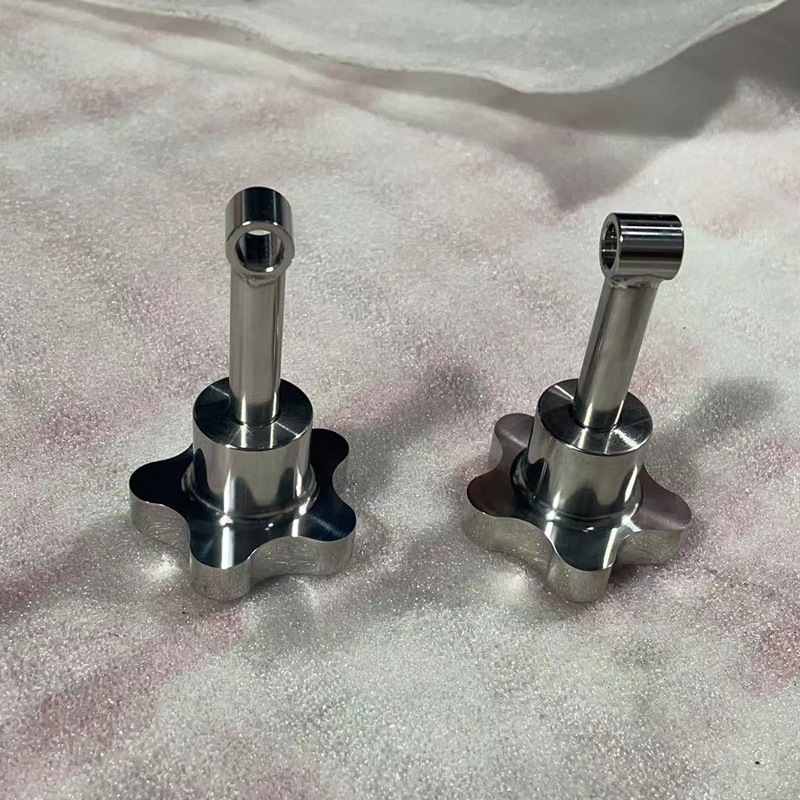
The mounting interface must match the component being adjusted. Female-thread knobs use an internal threaded insert, while male-stud knobs use an external threaded stud. Listed stud lengths range from 10 mm to 50 mm, with custom lengths available. A through-hole, plain bore, reamed bore, or keyway bore may be appropriate where a threaded interface is not required.
Material selection affects long-term service conditions. Thermoplastic materials are described as lightweight, impact-resistant, wear-resistant, chemically resistant, and insulating. Reinforced polyamide or glass-fiber nylon is listed for high mechanical strength, heat resistance, oil resistance, solvent resistance, and high torque resistance. Metal options include aluminum, while stainless steel inserts or studs are listed for corrosion resistance, tensile strength, and service life.
The product information lists operating temperatures from -20 degrees C to 120 degrees C as an example and identifies torque resistance, pull-out resistance, thread durability, impact resistance, temperature resistance, and wear resistance as relevant mechanical properties. Confirm the selected material, thread, insert, and finish against the actual equipment conditions.
Zhejiang Dream Industry Limited states that its quality system is ISO 9001 certified. Its listed certifications include ISO certificate ZT-Q-24120011S and patent certifications. A documented cooperation case supplied 65,000 adjustable clamping knobs to a CNC machine manufacturer in Italy for positioning and fixture-locking systems; the reported feedback cited locking performance, operating feel, and wear resistance during industrial use.
Data/Solution Comparison
| Selection Factor | Available Options or Guidance |
|---|---|
| Knob diameter | 15 mm, 20 mm, 25 mm, 30 mm, 40 mm, 50 mm, 60 mm, 70 mm, or 80 mm; choose according to hand clearance and required grip. |
| Height | 10 mm to 60 mm; select according to clearance around the adjustment point. |
| Thread and mounting | Female thread, male stud, or through hole. Metric sizes include M4, M5, M6, M8, M10, M12, and M16. |
| Material option | Thermoplastic, reinforced polyamide or glass-fiber nylon, phenolic, aluminum, or a stainless steel insert or stud. |
| Surface finish | Plastic matte, glossy, or textured finishes; metal zinc, chrome, nickel, black oxide, brushed, polished, sandblasted, or anodized finishes; stainless passivation, polishing, or electropolishing. |
| Order scale | Product MOQ is 50 pieces. Prototype CNC machining orders of 1 to 10 pieces and small-batch machining of 50 to 500 pieces are supported under the company business information. |
Frequently Asked Questions (FAQ)
What clamping knob diameter should I choose for machine adjustment?
Select from the listed 15 mm to 80 mm diameter range based on available space, hand clearance, and the level of manual grip needed. Verify that the knob will not interfere with adjacent guards, handles, or moving components.
Should I choose a female-thread clamping knob or a male-stud clamping knob?
Use a female-thread design when the mating component accepts an internal-threaded knob. Use a male-stud design when an external threaded stud is required. Confirm the required thread size and stud length before ordering.
Which material is suitable for a corrosion-resistant clamping knob?
For applications such as food machinery, marine equipment, outdoor equipment, and medical equipment, the product information lists SUS303, SUS304, and SUS316L stainless steel inserts or studs. Surface options for stainless steel include passivation, polishing, and electropolishing.
Final Conclusion & Recommendations
Specify the clamping knob by diameter, height, mounting type, thread size, stud length, material, shape, and required surface finish. Confirm mechanical requirements such as torque resistance, pull-out resistance, thread durability, and wear resistance for the intended equipment. Zhejiang Dream Industry Limited supports OEM manufacturing, ODM manufacturing, custom CNC machining services, bulk production, flexible small-batch orders, and export-oriented manufacturing. Its listed quality framework includes ISO 9001 certification and full dimensional inspection. For detailed technical solutions or support, please reach out via 86-15868979792.
About Us
Zhejiang Dream Industry Limited has more than 20 years of precision manufacturing experience and produces custom CNC-machined parts and assemblies in stainless steel, aluminum, brass, copper, carbon steel, and engineering plastics. Its capabilities cover design review, CNC turning and milling, surface treatment, precision casting, and final inspection for prototyping through high-volume OEM production. The company reports engineering and R&D capability in product design, structural optimization, CNC precision machining, mold development, surface finishing, and customized manufacturing. Its main products include precision CNC parts and components, handwheels and operator controls, bushings, pins, fasteners, couplings, gears, shafts, pipe fittings, fluid components, and other metal and plastic parts.
The company lists ISO certificate ZT-Q-24120011S and patent certifications, and has served clients across multiple industries.
Lastest
-
What key quality control documents should I request when auditing a potential CNC components factory?
2026-08-21 -
How long does it usually take a manufacturer to produce and ship custom CNC component prototypes?
2026-08-21 -
How do I choose between 3-axis and 5-axis CNC components for high-precision aerospace parts?
2026-08-21 -
Are there any emerging materials that could replace traditional steel CNC components to reduce weight?
2026-08-21 -
Can you explain the process of adding a custom logo and specific dimensions to a cast iron handwheel?
2026-08-21
SUBSCRIBE
INQUIRY